Coming Home: A New York Family’s Guide to Hospital Discharge and Home Care
The discharge conversation tends to arrive without much warning. A doctor mentions that the patient is medically stable, that the hospital’s work is largely done, and that going home in the next day or two is a realistic prospect. For the family, what follows is a compressed and often disorienting scramble — what does the home need to look like? Who is coming to help? What happens if something goes wrong on the first night?
The gap between a patient being ready to leave the hospital and a family being genuinely prepared to receive them is where most post-discharge complications originate. This guide is designed to close that gap — covering what the hospital arranges, what it does not, and what New York families need to have in place before the car pulls up outside.
What Happens at Discharge — And What Doesn’t
The hospital’s discharge process covers more than families often realize, but considerably less than many assume. The medical team will typically arrange follow-up appointments with the patient’s primary care physician and any relevant specialists. They will send medication orders to the patient’s pharmacy and provide a written list of current prescriptions as part of the discharge packet. Where medically indicated, equipment — oxygen, a hospital bed, a wheelchair — will be ordered for home delivery.
For patients who meet the eligibility criteria, the hospital will also assign a Certified Home Health Agency, or CHHA, to coordinate skilled short-term services at home. This is the component of post-discharge care that most families are least familiar with and most urgently need to understand. The CHHA sends a nurse to the patient’s home on the day after discharge to conduct an assessment — evaluating what the patient has, what they need, and what still has to be arranged. From that assessment, a plan of care is established that typically includes nursing visits, physical or occupational therapy, and the coordination of a home health aide through a Licensed Home Care Services Agency, or LHCSA.
For patients whose hospital stay involved any behavioral health component — anxiety, depression, cognitive changes, or any presentation that prompted a psychiatric consultation — families should be aware that New York State regulations introduced in 2024 and 2025 now require hospitals to conduct mandatory suicide risk screening and, where indicated, complete a community safety plan prior to discharge. The joint guidance from the NYS Office of Mental Health and the Department of Health, formalized in early 2026, standardized these requirements across emergency departments and inpatient psychiatric units statewide. In practice, this means the discharge process for such patients may involve additional assessments, a longer timeline than expected, and extra documentation in the discharge packet. It is worth asking the clinical team explicitly whether any of these steps apply and whether a follow-up appointment with a behavioral health provider has been arranged as part of the plan.
What the hospital does not arrange is the sustained, daily personal care that follows once the skilled short-term services taper off. That transition — from the CHHA’s coordination to the ongoing support of an LHCSA — is the family’s responsibility to initiate, and it is best initiated before the patient comes home rather than after.
Before You Leave the Hospital — The Conversations to Have
The hours before discharge are not the time to be passive. The medical and nursing team has information the family needs, and it will not always be volunteered unless asked for directly. The following questions are worth putting to the team explicitly before the patient leaves the building.
Has a CHHA been assigned, and has the day-after-discharge nursing visit been scheduled? This visit is the foundation of the post-discharge care plan, and confirming it is in place — with a name, a time, and a contact number — before leaving the hospital eliminates one of the most common sources of day-one confusion. Has a plan been made for what happens if the patient’s condition changes in the first 48 hours? Knowing the threshold for calling the doctor versus returning to the emergency room is not a question the hospital assumes families will ask, but it is one they should answer before anyone goes home.
Are all medications ordered, available at the patient’s pharmacy, and covered by their insurance? Prescription errors and insurance mismatches at discharge are more common than the system acknowledges. Is any durable medical equipment being sent to the home, and has delivery been confirmed for before the patient arrives? A hospital bed that arrives three days late is not a logistical inconvenience — it is a safety problem. And finally: has the family received the full written discharge packet, including the medication list, appointment schedule, and the care instructions specific to the patient’s condition? That packet is the operational blueprint for the first two weeks at home and should be treated as such.
The Home Environment — What Needs to Be Ready
Preparing a home for a returning patient is not the same task in every New York household, and the differences matter. A ground-floor Brooklyn apartment in Flatbush presents different challenges than a Queens row house in Jamaica Estates, a pre-war Manhattan building on the Upper West Side, or a Westchester Colonial with a staircase between the bedroom and the bathroom. The common thread is a systematic review of the patient’s likely movement through the space and the removal or mitigation of every obstacle along the way.
Clear pathways between the bedroom, bathroom, and any frequently used living spaces. Rugs secured or removed. Adequate lighting in hallways and at night. Grab bars in the bathroom if the patient’s mobility has been affected — these can be installed quickly and inexpensively and are among the most effective single interventions in preventing falls post-discharge. If the patient will be using a walker or wheelchair, measure the relevant doorways and confirm they are navigable before the day of arrival.
The home should also have an adequate supply of food appropriate to any dietary restrictions, a minimum two-week supply of any medications not yet ordered through the pharmacy, and a visible list of emergency contacts — the primary care physician, the CHHA coordinator, the LHCSA, the nearest family member — posted somewhere the patient and the aide can both find immediately. These details feel minor in isolation. In the first 72 hours at home, when everyone is tired and the routines have not yet been established, they are not minor at all.
The First 48 Hours — What to Expect
The first two days at home are typically the most demanding of the entire post-discharge period, and managing expectations for that period is itself a form of preparation. The CHHA nurse will arrive for the assessment visit and will spend time evaluating the patient, reviewing the medication list, and establishing the initial plan of care. Therapists — physical, occupational, or speech, depending on what has been ordered — will begin scheduling their visits, which may not start until day two or three. The home health aide, provided through an LHCSA, will have their own first visit, which carries its own adjustment period for both the patient and the family.
The communication structure in these early days can feel fragmented. The CHHA coordinator, the aide’s supervising nurse at the LHCSA, the primary care physician’s office, and the family are all operating simultaneously with varying levels of information. The family’s role in this period is to be the connective thread — confirming that the various parties know what the others are doing, flagging discrepancies, and ensuring that the aide’s observations about the patient’s condition are communicated upward to the appropriate clinical contacts. For families who want a more detailed picture of how that first week unfolds, our guide to what to expect from your first week of home care in New York covers the day-by-day reality in full.
Medication and Equipment — The Errors That Happen Most Often
Post-discharge medication management is an area where errors are genuinely common and the consequences are genuinely serious. The discharge packet contains the medication list as it stood at the time of discharge, but it does not account for what the pharmacy actually has in stock, whether the insurance covers the prescribed brand or requires a generic, or whether the dosage has been adjusted since the list was printed. Before the first doses are given at home, the list in the discharge packet should be checked against what has actually arrived from the pharmacy — medication by medication, dosage by dosage.
Durable medical equipment presents a parallel problem. The supply chain between the hospital’s ordering system and the equipment company’s delivery operation is longer and less reliable than it appears, and the item that arrives is not always the item that was ordered. Masks, tubing, and accessories in particular frequently arrive mismatched with the equipment they are intended for. Check the make and model of anything delivered against the prescription, and verify that no relevant recalls are in effect. If there is a pharmacist in the family’s circle — or even a pharmacist at the patient’s regular pharmacy with whom the family has a relationship — having a second pair of eyes review the full medication list for interactions and red flags is time well spent.
Navigating New York’s Home Care System After Discharge
New York State’s home care system is one of the most comprehensive in the country and, correspondingly, one of the more complex to navigate. Understanding how its components fit together is what allows families to use it effectively rather than being managed by it.
The CHHA handles the skilled, short-term phase of post-discharge care — the nursing visits, the therapy sessions, the initial coordination. That phase has a defined endpoint, typically when the patient is deemed to have reached a stable plateau in their recovery. What follows — the ongoing personal care that a patient with lasting support needs will require — is provided by a Licensed Home Care Services Agency. In New York, LHCSAs are licensed and regulated by the New York State Department of Health, and the home health aides and personal care assistants they place work within a defined scope of practice established by that regulatory framework.
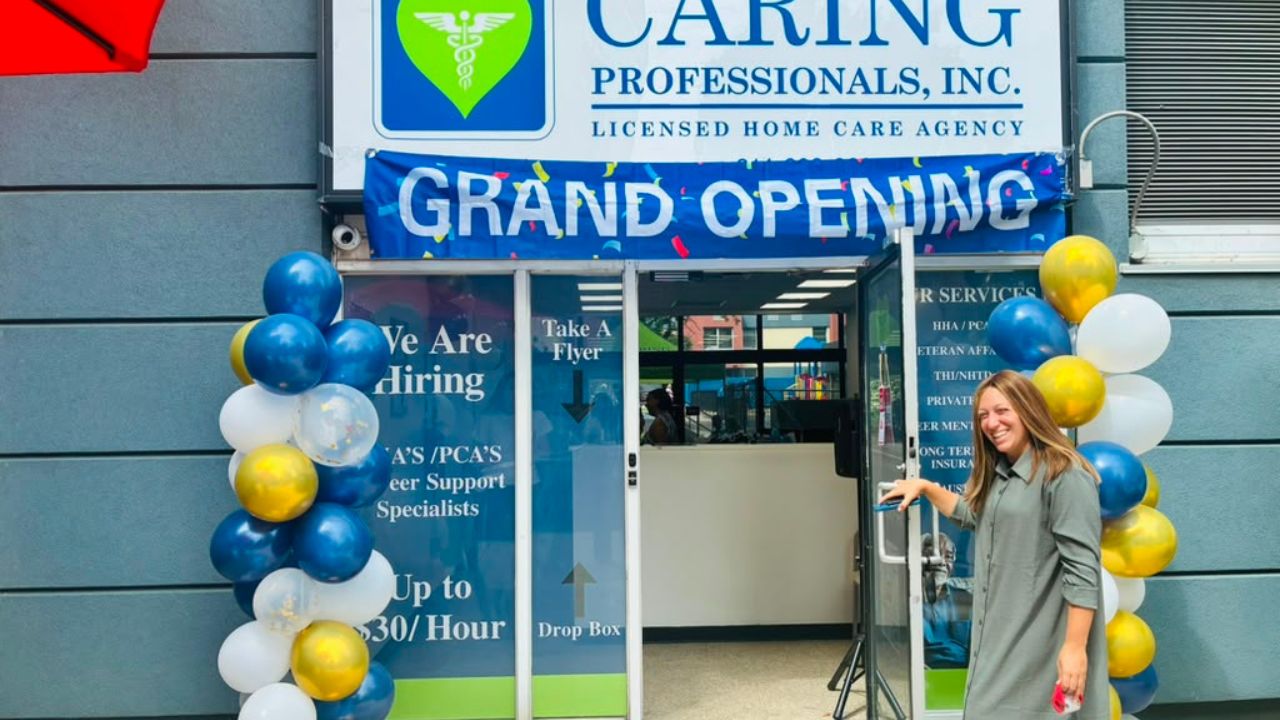
Caring Professionals has been providing home care services in New York as a licensed LHCSA since 1994. We work alongside CHHAs throughout the post-discharge transition, coordinating placement of home health aides and personal care assistants across Brooklyn, Queens, the Bronx, Manhattan, Westchester, and Suffolk County. Our care coordinators are familiar with the discharge processes at hospitals across all six service areas — Maimonides and Kings County in Brooklyn, NewYork-Presbyterian Queens and Jamaica Hospital in Queens, Montefiore in the Bronx, Mount Sinai and NYU Langone in Manhattan — and we are equipped to move quickly when a family’s timeline is compressed. For families who are navigating Medicaid or Managed Long Term Care funding for the first time, our guide to how Medicaid home care works in New York is the right starting point before that conversation begins.
The broader landscape of home care services in New York — the agencies, the funding pathways, the borough-level differences in what is available and how to access it — is detailed on our New York home care page, which is the most comprehensive single resource we maintain for families at the beginning of this process.
A Discharge Checklist for New York Families
The following is a practical reference organized by phase. It does not replace the specific guidance of the medical team, but it covers the ground that families most commonly find themselves unprepared for.
Before discharge, confirm that a CHHA has been assigned and that the day-after nursing visit is scheduled with a specific time and contact number. Verify that all medications are ordered, available, and covered by insurance. Confirm that any required equipment has been ordered and will be delivered before the patient arrives home. Collect the full written discharge packet and read it before leaving the building. Ask explicitly about the threshold for calling the doctor versus returning to the emergency room in the first 48 hours.
On the day of discharge, bring a second person if possible — one to manage the patient, one to manage the paperwork, the personal belongings, and the transport. Confirm that the home environment has been prepared: pathways clear, bathroom safety measures in place, lighting adequate, emergency contacts posted. Have the first doses of any time-sensitive medications accessible and ready before the patient arrives.
In the first 24 hours at home, conduct a medication check — discharge list against pharmacy delivery, item by item. Confirm the CHHA nurse’s visit is on schedule. Verify that the aide’s first visit through the LHCSA has been confirmed and that the supervising nurse’s contact number is saved. Notify the primary care physician’s office that the patient is home and ask to confirm the follow-up appointment.
Through the first week, keep a running log of any changes in the patient’s condition, appetite, sleep, or mood — noting dates and times. Bring that log to every medical appointment and share it with the CHHA coordinator. Confirm the therapy schedule and ensure someone is present for the initial visits if the patient cannot reliably communicate their needs independently. If anything in the care arrangement is not working — the wrong equipment, a communication breakdown between providers, an aide mismatch — address it immediately rather than hoping it resolves. The first week sets the patterns for the weeks that follow.
How Caring Professionals Supports New York Families Through This Transition
The post-discharge period is not a single event but a sustained transition, and having a reliable LHCSA in place before the patient comes home — rather than scrambling to arrange one afterward — changes the experience significantly. Caring Professionals has been part of that transition for New York families for more than thirty years, placing home health aides and personal care assistants who speak more than twenty languages and are matched to each client by language, cultural background, and individual preference.
Our offices in Forest Hills, Brooklyn, and the Bronx mean that our coordinators know the neighborhoods, the hospitals, and the community resources that are relevant to your family’s specific situation. We accept Medicaid, Managed Long Term Care, long-term care insurance, and private pay, and we are experienced in helping families understand which funding pathway applies to their circumstances. When you are ready to have that conversation, you can reach us at (718) 333 1400 or through our contact page at caringprofessionals.com/contact-us/.
More articles on New York Home Care from Caring Professionals:
- Choosing a Home Care Agency in New York: What to Look For
- What Does a Home Health Aide Do? A New York Family’s Guide
- How Medicaid Home Care Works in New York: A Family Guide
- When the Aide Becomes Part of the Family: Building Strong Relationships with Home Care Workers
- From Spare Change to Deep Connection Down Memory Lane
- Loneliness in Caregiving: Breaking the Silence and Finding Connection