The Best Home Care Agencies in New York City (2026 Guide)
A discharge planner tells you your mother is coming home Thursday and will need an aide seven days a week. It’s Tuesday. You search for home care in New York and get back a hundred agencies whose websites say the same four things: compassionate caregivers, personalized care plans, available 24/7, free consultation.
Almost none of those pages tell you what you actually need to know, which is whether the agency covers your borough, whether it can bill your mother’s Medicaid plan, what it costs, and how quickly it can get someone through the door.
In this guide you’ll learn what changed with CDPAP in 2025 and why most published comparisons are now out of date, what home care actually costs in New York in 2026, and where nine of the larger providers fit, with the pros and cons of each. We’ve put ourselves first because this is our guide, but we’ve also written down what every agency here is genuinely better at, including the cases where that isn’t us.
| Agency | Founded | Coverage | Accreditation |
|---|---|---|---|
| Caring Professionals | 1994 | All 5 boroughs, Nassau, Suffolk, Westchester, Rockland, Orange, Sullivan | NYS DOH licensed, LHCSA |
| CareYaya | Platform, not an agency | NYC metro | Not a licensed agency |
| All Heart Homecare | ~2011 | 5 boroughs | BBB accredited |
| BAYADA | 1975 | National, incl. NY | CHAP |
| Edison Home Health Care | Help at Home since 2022 | 5 boroughs, Nassau, Suffolk, Westchester, Rockland, Orange | Joint Commission |
| Preferred Home Care of NY | Now Help at Home | NY, via Help at Home | Not published |
| Amazing Home Care | Not published | 5 boroughs, Westchester, Nassau | NYS DOH licensed, CMS |
| Allegiant Home Care | Not published | 5 boroughs, Nassau, Suffolk, Westchester | Not published |
| Heart to Heart | 2006 | 5 boroughs, Westchester (offices in Bronx, Brooklyn) | Joint Commission |
Quick comparison
CareYaya is the only provider on this list that publishes a rate, a flat $20 an hour. Everyone else quotes after an assessment, which is normal for the sector but makes comparison harder than it should be.
What home care costs in New York in 2026
What you pay depends almost entirely on who’s paying, and the gap between the answers is enormous.
If care is authorized through Medicaid or a managed long term care plan, your out of pocket cost is usually nothing. The plan pays the agency directly for the approved hours. The hard part isn’t the money, it’s getting the hours authorized in the first place, and that’s where an agency that handles the paperwork properly earns its keep.
If you’re paying privately, expect roughly $25 to $40 an hour in New York City. Care.com puts the New York average starting rate at $23.16 an hour as of August 2026, with New York City running about 8% above that. Manhattan sits at the top of the range, while Brooklyn, Queens, the Bronx and Staten Island tend to land in the middle. Short notice, overnight, weekend and higher acuity work all push the number up.
At those rates, 20 hours a week runs somewhere around $2,200 to $3,500 a month, and 40 hours a week roughly $4,300 to $6,900. Overnight coverage through a traditional agency is commonly quoted around $300 to $400 a night.
Under CDPAP the money works differently, because the person you choose becomes the paid caregiver and Medicaid funds it. In New York City in 2026 personal assistants earn a base wage in the low twenties per hour plus the downstate wage parity supplement, with overtime at time and a half beyond 40 hours, all paid weekly through PPL. Published figures vary by source and by plan, so treat any single number you read online as approximate and confirm with your plan.
One floor worth knowing: New York sets a minimum wage specifically for home care aides, which is higher than the general minimum and rose again in January 2026 for New York City, Long Island and Westchester. Any agency quoting you a private rate near that floor is not leaving room for supervision, backup cover or insurance, and you should ask how they’re doing it.
What changed with CDPAP in 2025, and why most guides are wrong
If you’ve read anything about the Consumer Directed Personal Assistance Program written before 2025, throw it out.
CDPAP lets a Medicaid recipient hire someone they already know, including most family members, and have that person paid to provide care. Until recently, more than 600 separate organizations across New York acted as fiscal intermediaries for the program, handling payroll and paperwork. On April 1, 2025 the state replaced all of them with a single statewide fiscal intermediary, Public Partnerships LLC, usually written as PPL.
Every consumer and every personal assistant now registers with PPL and gets paid through PPL. The transition was rough. The Department of Justice sued over the state’s selection of PPL, and in July 2026 a federal judge preliminarily approved a $162 million settlement covering roughly 200,000 home care workers over payroll and benefits problems during the changeover.
Here’s what that means when you’re comparing agencies. No agency in New York is a CDPAP fiscal intermediary anymore. What good agencies do now is act as facilitators, helping you enroll, keeping your registration current, and sorting out problems with PPL when your caregiver’s pay doesn’t arrive. That’s a real service and it takes real staff, but it’s a different thing from what agencies used to do.
So when an agency’s website still says it is “a fiscal intermediary for the CDPAP program,” that page hasn’t been updated in over a year. Worth checking, because it tells you something about how closely the agency tracks a program its clients depend on.
How to evaluate a home care agency in New York
Coverage is the first filter and it eliminates more options than people expect. Agencies license and staff by region, and an agency with deep Brooklyn coverage may have nobody available in Westchester. Check the specific neighborhood, not just the borough.
Language matching matters more than most families anticipate. An aide who shares your parent’s language changes the relationship from supervised assistance into something closer to company, and in a city where a large share of older adults speak something other than English at home, an agency’s language range is a practical measure of whether it can match your family at all.
Ask who handles the paperwork. Medicaid authorization, managed long term care approvals, and CDPAP registration through PPL all involve forms and follow up, and the difference between an agency that does this for you and one that emails you a PDF is measured in weeks.
Ask what happens when an aide calls out sick, because that’s the question that separates agencies once care is actually running. An agency with a real bench sends a replacement. An agency without one calls to say nobody’s coming, and you take the day off work.
Finally, check licensure. New York licenses home care services agencies through the Department of Health, and you can look up any provider on NYS Health Profiles. Accreditation from the Joint Commission or CHAP is voluntary and goes beyond the state minimum.
We’ve covered each of these in more depth in our guide to choosing a home care agency in New York.
1. Caring Professionals
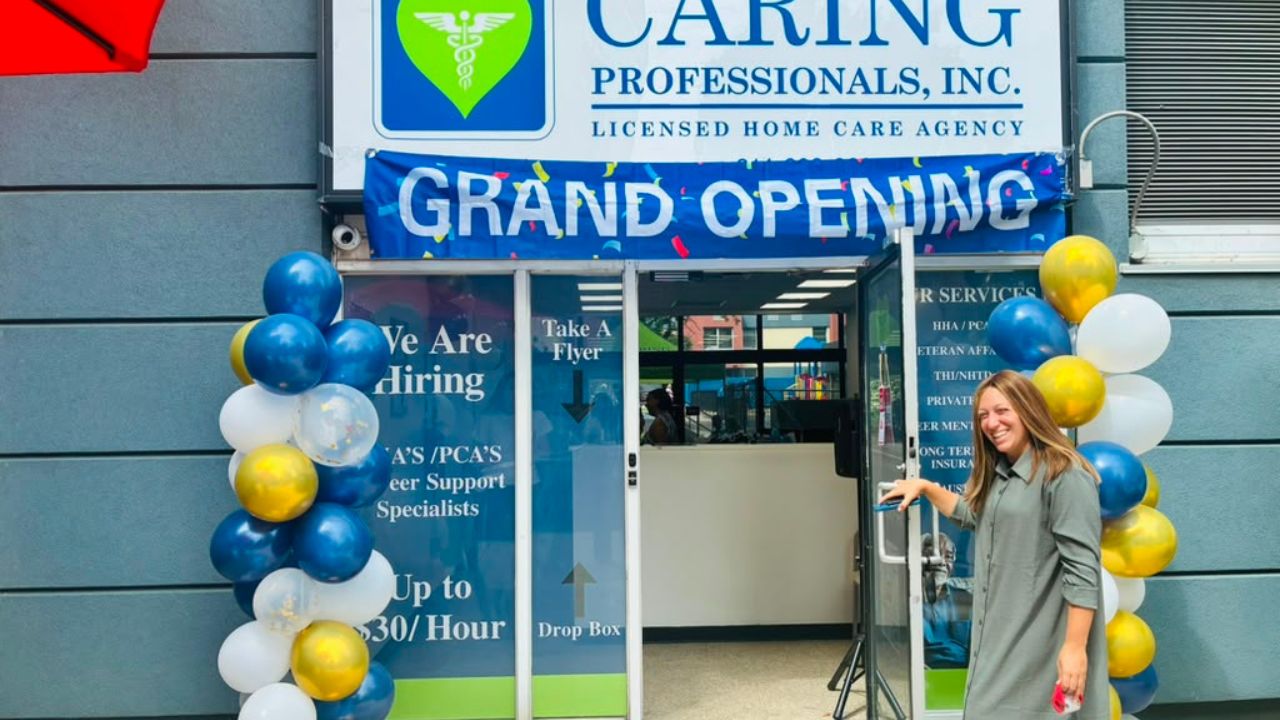
Placing caregivers in New York homes since 1994, from six offices, and licensed across all five boroughs plus Nassau, Suffolk, Westchester, Rockland, Orange and Sullivan under two operating certificates. The company says it has helped more than 75,000 New Yorkers. The business is built around matching rather than scheduling, and it trains PCAs in house, which is part of why requests can usually be filled from its own roster.
Pros
- Caregivers working in nine languages, including Russian, Spanish, Mandarin, Cantonese, Polish, Farsi, Hungarian and Haitian Creole
- Matching on language, culture and personality rather than availability alone
- The widest licensed footprint of any agency here, reaching past the boroughs into Nassau, Suffolk, Westchester and the lower Hudson Valley
- Licensed for nursing, medical social services, and occupational, physical, respiratory and speech therapy alongside aide and personal care, which is a broader service authorization than most agencies on this list hold
- Two programs almost nobody else runs: Caring Companions for Holocaust survivors, and a dedicated veterans service
- In house PCA training, so staffing doesn’t depend on the outside labor market
- CDPAP facilitation alongside agency-directed care, so families can combine both
Cons
- The website understates the licensed footprint and service range, so what’s advertised and what the state authorizes don’t line up
- Nursing and therapy are licensed but the agency leads with aide and personal care, so confirm current capacity directly for ventilator, tracheostomy or complex wound cases
- Rates aren’t published, so private pay families need an assessment before they get a number
Best for: New York families who want an aide matched to their parent’s language and culture, especially in the Russian, Chinese, Polish, Farsi, Hungarian or Haitian Creole speaking communities, and families combining CDPAP hours with agency hours.
2. CareYaya
Not an agency in the same sense as the rest of this list. CareYaya is a platform connecting families with pre health students heading toward medical and nursing careers, who provide companionship and non medical support. It accepts around 20% of applicants and families rate it 4.9 out of 5.
Pros
- Publishes a flat $20 an hour, including nights, weekends and 24 hour shifts, well below the $25 to $40 agency range
- Overnight coverage around $175 a night against $300 to $400 through a traditional agency
- No contracts or weekly minimums, though sessions under four hours are hard to fill
- Student caregivers are often more engaged than hourly agency staff, and many are genuinely interested in the person
Cons
- Not a licensed Medicaid home care agency, so it can’t bill Medicaid or a managed long term care plan and you pay out of pocket
- Roughly seven days notice needed to match a caregiver, which rules it out for an urgent discharge
- Weekday daytime coverage is hardest to fill because caregivers are in class
- Non medical support only, with no skilled nursing or clinical care
- Caregivers are students rather than certified home health aides
Best for: Private pay families whose relative is largely independent and mainly needs company, transport and overnight presence, and who can plan a week ahead.
3. All Heart Homecare Agency
Around 14 years old, operating across all five boroughs, and the most locally decorated agency here.
Pros
- Strong local recognition: Crain’s Best Places to Work in NYC 2025, Best of Brooklyn 2025, BBB accreditation
- 4.8 star Google average across a large review base
- Multilingual staff with deliberate language matching
- Private duty nursing alongside aide services, so clinical needs stay in house
- Free transportation to medical appointments, which matters more than it sounds when a parent has limited mobility
- Specialized Alzheimer’s and dementia care, plus Holocaust survivor and veteran programs
Cons
- Markets itself to the five boroughs only. It is licensed for Westchester but doesn’t advertise it, so ask directly, and Long Island families need someone else
- Shorter track record than the 30 year agencies on this list
- No published rates
Best for: Families inside the five boroughs who want a well reviewed all rounder and value dementia care experience.
4. BAYADA Home Health Care
Founded in 1975, now operating internationally across eight service lines. The clinical depth here is real and unusual.
Pros
- Fifty years of operating history and CHAP accreditation
- Eight service lines including hospice, pediatric home health, private duty nursing and ABA therapy for autism
- Runs its own simulation labs and a nurse residency program, which shows in clinical staff quality
- Depth in pediatric and hospice care that local agencies can’t match
Cons
- A national operation where New York City is one market among many
- Little of the borough level knowledge or language matching a New York specific agency accumulates
- For straightforward home health aide hours you’re paying for infrastructure you don’t need
- CDPAP availability varies by market rather than being a core offering
Best for: Families needing skilled nursing rather than personal care, or arranging pediatric or hospice care at home.
5. Edison Home Health Care
A Brooklyn agency that has been part of Help at Home since 2022, with its main office on 39th Street and recruitment offices in Brooklyn, Queens, the Bronx, Suffolk and Rockland.
Pros
- Joint Commission accreditation, the stricter of the two accreditations common in this sector
- A wider footprint than its Brooklyn roots suggest: it lists all five boroughs, Nassau, Suffolk, Westchester, Orange and Rockland as its service area
- Backed by a national operator with the administrative capacity that brings
Cons
- No longer offers CDPAP. Its own CDPAP page now states that Edison “does not administer” the program, while Help at Home’s Edison page still describes it as a fiscal intermediary, so the two sites contradict each other
- Part of a national group rather than an independent agency, which some families find less personal
- No published rates or founding date
Best for: Brooklyn and Queens families who want an accredited agency with national backing and have no need for CDPAP.
6. Preferred Home Care of New York
Once one of the state’s larger CDPAP operations, based in Borough Park. It now sits under Help at Home, and the old domain redirects there.
Pros
- Backed by a large national operator with the administrative capacity that brings
- Will often hire a caregiver you already trust and put them on staff directly
- Caregiver benefits package with medical, dental, vision and 401(k), plus weekly pay, which helps retention
- RN supervised care plans and a 24/7 support line
- A credible exit route for families exhausted by CDPAP payroll problems
Cons
- No longer the CDPAP provider it was, and the current positioning actively steers families away from the program
- The brand you were searching for effectively no longer exists as a standalone agency
- Coverage detail for New York is thin on the current site
Best for: Families who want to leave CDPAP behind, keep their existing caregiver, and hand all the administration to someone else.
7. Amazing Home Care
A broad footprint across the city and into Westchester and Nassau, licensed by the state Department of Health and part of the Centers Health Care network.
Pros
- Covers all five boroughs plus Westchester and Nassau
- Runs the NHTD and TBI waiver programs, which relatively few agencies are set up to handle
- A structured aide pairing process rather than assignment by availability
- Backed by a large provider network, so capacity is rarely the constraint
Cons
- Part of a large network rather than an independent agency, which some families find less personal
- Describes a diverse team without specifying languages, so ask directly if language matching matters
- Founding date and rates aren’t published
Best for: Families needing NHTD or TBI waiver services, and families who value the capacity of a large provider network behind their agency.
8. Allegiant Home Care
An AccordCare company and the most clinically focused provider on this list.
Pros
- Handles spinal cord injury, traumatic brain injury, stroke, complex orthopedic cases, and ventilator and tracheostomy care
- Internal clinical team supporting field caregivers
- Accepts private pay, insurance, Medicare and Medicaid, workers’ compensation and veteran benefits
- Covers the five boroughs plus Nassau, Suffolk and Westchester
- Dementia and Alzheimer’s care and a dedicated veteran service
Cons
- Its site doesn’t mention CDPAP at all, so consumer directed care isn’t the route here
- Part of a multi-state group, so New York is one market among several rather than the whole business
- No languages, founding date or accreditation detail published
Best for: Someone coming out of hospital with a high acuity clinical need who requires nursing level care at home.
9. Heart to Heart Home Care
Providing home care since 2006 from offices in the Bronx and Brooklyn, licensed across the five boroughs and Westchester, and Joint Commission accredited.
Pros
- Joint Commission accreditation, which goes beyond the state licensing minimum
- Runs day habilitation, behavioral health services and residential group homes alongside home care
- Can coordinate I/DD and behavioral health support with personal care under one roof
- Contracts with most Certified Home Health Agencies and managed long term care plans in New York
- Willing to build unusual care arrangements rather than fitting families to a template
Cons
- Offices only in the Bronx and Brooklyn, so check availability elsewhere in the city and in Westchester
- Home care is one line of business among several rather than the whole company
- Languages and rates aren’t published
Best for: Families where the person needing care has an intellectual or developmental disability, or needs behavioral health support alongside personal care.
Agency-directed care or CDPAP: which one fits
Agency-directed care means the agency employs the aide, trains them, schedules them, and replaces them when they’re unavailable. You get a professional you didn’t have to find, and you’re not responsible for anything administrative. The tradeoff is that you don’t choose the person.
CDPAP means you choose. Your daughter, your neighbor, the friend who’s already been helping three days a week: if they’re eligible, they get paid. For an older adult uncomfortable with a stranger providing personal care, or who speaks a language you can’t reliably match, this solves a problem no agency can solve. The tradeoff is that you’re directing care yourself, and since April 2025 that means working through PPL for registration and payroll.
Most families we talk to end up combining the two, using CDPAP for the hours a family member can cover and agency aides for everything else.
Questions to ask before you sign
- Are you licensed by the New York State Department of Health, and accredited by the Joint Commission or CHAP?
- Do you have aides available in my specific neighborhood, not just my borough?
- Which languages do your available aides speak?
- What’s your hourly rate for my situation, and does it change for nights, weekends or holidays?
- How soon can care start, and what’s your process if I need someone this week?
- Who handles the Medicaid or managed long term care paperwork, you or me?
- What happens when my aide is sick? Do you send a replacement the same day?
- If I’m using CDPAP, what exactly do you do for me now that PPL handles payroll?
- Is there a minimum number of hours, and is there a contract?
Where to start
The right agency depends on three things: your borough, how many hours you need, and who’s paying. A Brooklyn family with a Medicaid authorization and a Russian speaking parent has a different shortlist than a Westchester family paying privately for overnight companionship, and neither shortlist looks like a ranked top ten.
So use this guide to get to three names, then call all three and ask the questions above. The answers arrive fast, and the agency that can tell you plainly what it charges, when it can start and who’s handling your paperwork is usually the one still answering the phone in six months.
If you want to talk through your situation, Caring Professionals has been doing this in New York since 1994, and we’ll tell you honestly if someone else on this list is the better fit.